PLANNING
You wish to draft advance medical directives
Advance medical directives allow you to define your medical wishes in case you can no longer express them. We help you draft them in compliance with Swiss law.
Swiss law offers a great deal of freedom when it comes to advance medical directives. It allows every citizen to define their treatment wishes in detail and to appoint a therapeutic representative in case they lose capacity.
Over the years, these directives have become an essential tool in Swiss health policy. They make it possible to adapt medical intervention to each person’s wishes, striking the right balance between withdrawing treatment and its opposite, sometimes described as overtreatment.
Over the years, we have built a rich library of tailored clauses for advance directives. It covers, in particular, dementia, mental health, end‑of‑life wishes, and the involvement of family.
Advance directives also cover mental health. They allow you, for example, to forbid certain medications or treatments you do not wish to receive. Many people refuse neuroleptics or electroconvulsive therapy. That is their choice, and it must be respected. Conversely, others may distrust their own judgment and wish that certain treatments—treatments they are radically opposed to during a crisis—should nevertheless be administered. Here again, it is their choice.
In the area of dementia, advance directives are especially important. This is particularly true for people with a family history or an increased likelihood of developing dementia. Most clients facing this situation provide for a withdrawal of treatment when the illness is too advanced to allow options such as Exit, while avoiding prolonging a life they no longer consider worth living.
Above all, advance directives are the expression of your vision. It is your life. We defend one thing: freedom of choice. This freedom is an individual right and must not be judged morally.
Our approach is to guide you—among other things—using a chart showing the different axes of approach:
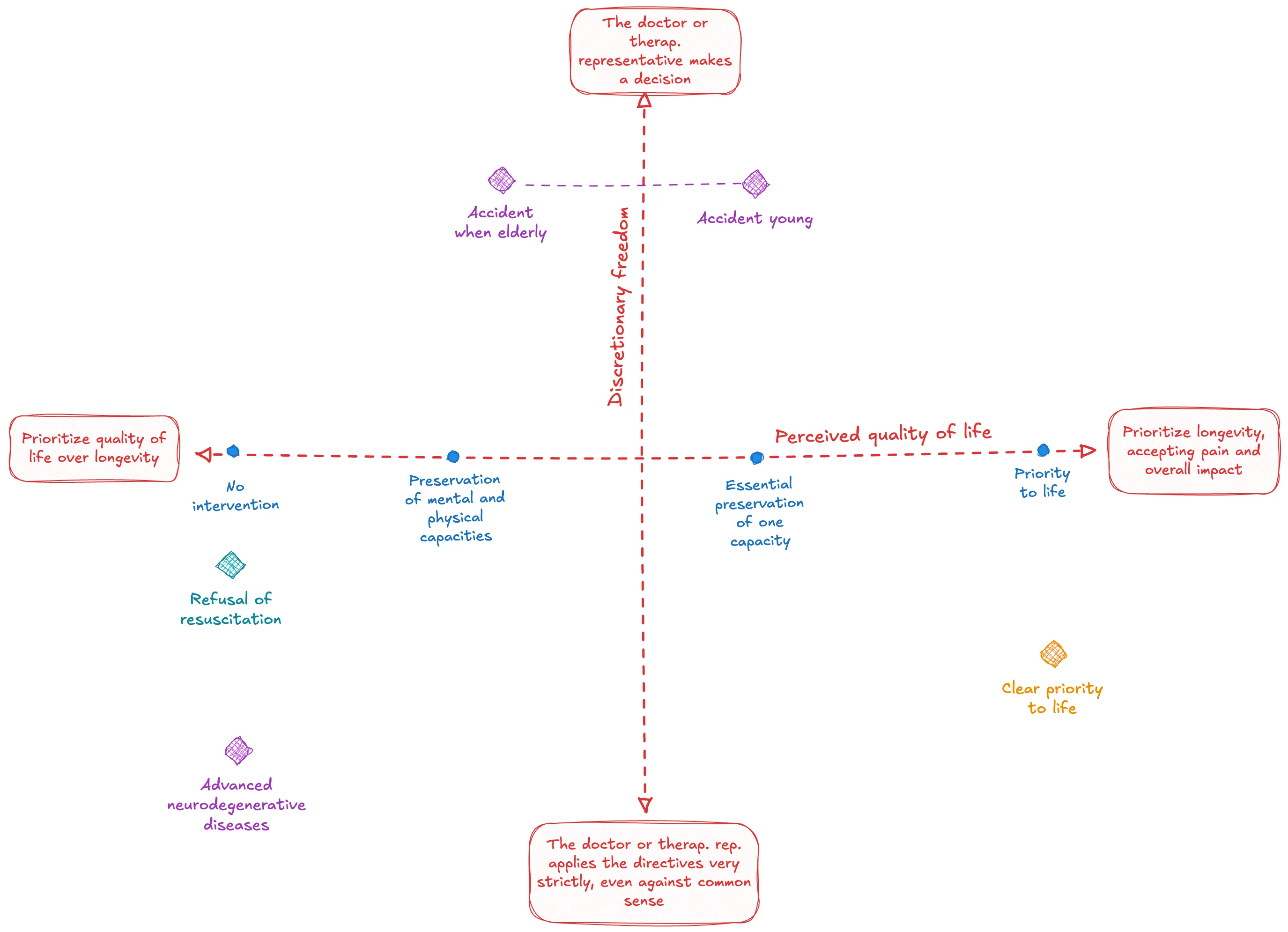
and to highlight the profile that suits you.
Different situations may call for different attitudes. For example, a young person who has had an accident may wish to give doctors some flexibility to interpret instructions in light of the circumstances, whereas a person seeking to prevent a long Alzheimer’s disease may prefer that any clear instructions to withdraw treatment be followed strictly.
This way of working is our answer to the largely uniform approach advocated by the medical profession, which, perhaps for reasons of simplification and ease of interpretation, promotes choosing a single attitude toward life. Yet that single attitude is far too simplistic given the importance of choice.
We also have extensive experience in legally defining quality of life. This is the most fundamental notion when it comes to positioning oneself on the horizontal axis and expressing, with sufficient clarity and enforceability vis‑à‑vis the medical profession, one’s fundamental attitude.
YOUR TEAM
Your dedicated lawyers


TESTIMONIALS
What our clients say
★★★★★Thank you for the work and consideration given to my case
★★★★★Excellent work, very professional. I thank the entire team and especially Me Sevig for their help with my very complicated case. They were always attentive and gave very good advice.
PLANNING
See also
- You plan signing a pre-nup, a post-nup or plan your inheritance
- You intend to plan your retirement
- You would like to appoint us as executor of the will
- You wish to plan your estate
- You wish to draft a mandate in case of incapacity
- You are relocating to Switzerland and wish to understand the impact on your marital situation
CONTACT
OTHER EXPERTISE
Discover our other areas
Succession
You intend to settle an existing estate
Settling an estate in Switzerland can often be achieved through straightforward formalities when all heirs are in agreement. However, when an heir refuses to cooperate, Swiss courts have the authority
Divorce & Separation
You are headed for a divorce
Are you facing divorce proceedings in Switzerland and seeking expert guidance through this challenging time? Our specialized family law team brings decades of experience in both amicable and contentio
Protection
You want to protect an adult
Are you concerned about a loved one's assets being at risk due to undue influence? Swiss law provides robust protective measures for both domestic and international cases. Learn how we can help safegu